Technology is evolving at an unprecedented pace, and software development is at the center of this revolution. The rise of AI-powered coding assistants has left many developers questioning their future. Is AI replacing developers?
AI coding tools like GitHub Copilot, ChatGPT, Tabnine, and Amazon CodeWhisperer are becoming increasingly powerful. They can autocomplete code, generate entire functions, suggest optimizations, and even debug errors. While some developers embrace these advancements, others worry: Will AI replace developers in the future?
The concern is particularly intense among MERN stack developers, who rely on their coding expertise to build full-stack applications. With AI generating front-end components, back-end logic, and database configurations, the question arises: Does AI replace developers completely? Is it just a matter of time before AI replace MERN stack developers and other specialists?
The debate is heating up, but before we jump to conclusions, let’s take a detailed, analytical, and fact-based look at whether AI replacing developers is a real possibility—or just another technology hype cycle.
The Rise of AI in Software Development
Artificial intelligence has been making its way into software development for years, but in the past, its role was limited to static analysis tools, code linters, and automated testing frameworks. Today, AI coding assistants can do far more than just highlight syntax errors. This shift has sparked discussions about AI replacing developers and whether we are heading toward a future where human developers become obsolete.
The modern AI-powered coding assistants are built using deep learning models trained on massive datasets of open-source and proprietary code. These models analyze patterns in existing codebases and use them to generate relevant suggestions, often with impressive accuracy. As AI advances, many are beginning to ask, “Will AI replace developers in the future?” The concern is particularly strong among professionals in specialized fields, with many MERN stack developers wondering, “Will AI replace MERN stack developers?”
How AI Coding Assistants Work
Modern AI coding assistants leverage advanced machine learning models trained on vast repositories of code. These models analyze extensive datasets, including open-source projects, proprietary code, and programming documentation, to understand coding patterns, best practices, and common solutions. By recognizing these patterns, AI coding assistants can generate relevant code snippets, suggest improvements, detect errors, and even offer explanations for complex logic.
When a developer inputs a prompt or starts writing code, the AI predicts the next lines based on context, syntax, and learned patterns. Some AI assistants integrate seamlessly with development environments, offering real-time suggestions, autocompletion, and debugging support. This not only accelerates coding but also enhances accuracy by reducing syntax errors and improving code efficiency.
Additionally, AI-powered coding tools continuously improve through reinforcement learning and user feedback. As developers interact with these systems, the models refine their suggestions, adapting to various programming styles and project-specific requirements. This makes AI coding assistants valuable for both beginners seeking guidance and experienced programmers aiming to optimize their workflow.
Key Players in AI-Powered Coding
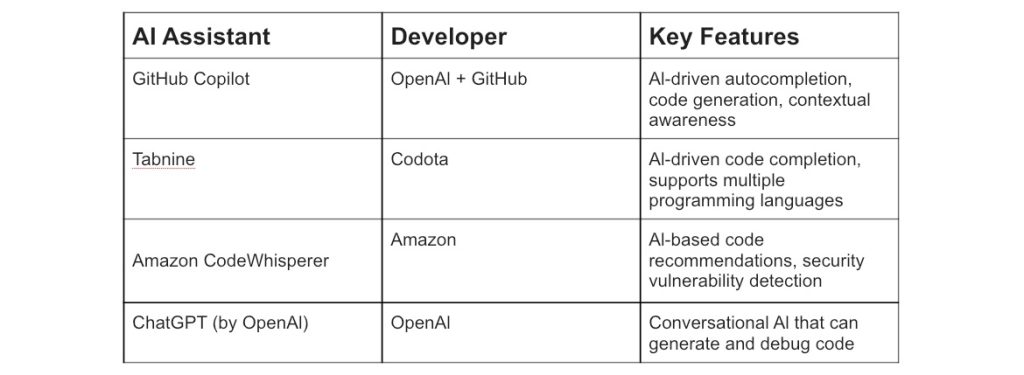
These tools are undeniably powerful, revolutionizing the way developers write and optimize code. However, does AI have the capability to replace human developers entirely? The answer isn’t so straightforward. While AI coding assistants can automate repetitive tasks, generate code snippets, and even debug errors, they still lack true human intuition, creativity, and problem-solving abilities.
Now, let’s take a closer look at what AI can and can’t do in the world of software development.
What AI Can Do Well
AI coding assistants have transformed the way developers work, offering a range of benefits that enhance productivity, code quality, and learning opportunities. Here are some of the key areas where AI excels:
1. Speed Up Development
One of AI’s biggest advantages is its ability to accelerate the development process. AI-powered tools can generate boilerplate code, automate repetitive tasks, and provide real-time suggestions, allowing developers to focus on higher-level problem-solving. This is especially beneficial for MERN (MongoDB, Express.js, React, Node.js) stack developers, who often work with complex full-stack applications and need to quickly scaffold projects. By reducing time spent on routine coding tasks, AI enables developers to iterate faster and bring products to market more efficiently.
2. Improve Code Quality
AI doesn’t just help with writing code—it also enhances code quality. AI-powered tools analyze code for potential issues, detecting bugs, security vulnerabilities, and inefficiencies before deployment. These tools use machine learning models trained on vast datasets of code, allowing them to identify patterns associated with common errors and best practices. By catching mistakes early, AI helps developers write cleaner, more secure, and more efficient code, ultimately reducing the need for extensive debugging and rework.
3. Assist Junior Developers
For those new to coding, AI serves as an invaluable learning companion. AI-powered coding assistants can explain complex programming concepts, provide relevant documentation, and suggest best practices in real time. Junior developers can ask AI tools for clarification on specific syntax, data structures, or design patterns, making the learning process more interactive and efficient. Instead of spending hours searching for answers online, beginners can receive instant guidance, allowing them to improve their coding skills faster and with greater confidence.
4. Enhance Cross-Language Coding
Developers often need to work across multiple programming languages, whether for full-stack development, system integrations, or learning new technologies. AI can simplify this process by translating logic between languages, helping developers adapt their code to different syntaxes and paradigms. For instance, an AI assistant can help a Python developer understand how to implement the same logic in JavaScript or C++, reducing the learning curve when working with unfamiliar tech stacks. This capability is particularly useful for teams working on multilingual projects, enabling smoother collaboration and reducing the risk of syntax errors when switching between languages.
By leveraging these AI capabilities, developers can work more efficiently, produce higher-quality code, and enhance their overall programming expertise. However, while AI is a powerful tool, it is most effective when used alongside human expertise and critical thinking.
What AI Can’t Do (Yet)
Despite its impressive capabilities, AI coding assistants still have significant limitations. While they can streamline development and improve efficiency, they fall short in areas that require human intuition, creativity, and contextual understanding. Here are some of the key challenges AI faces:
1. Think Like a Human
AI coding assistants do not possess true problem-solving abilities in the way that human developers do. They generate code based on patterns and statistical probabilities rather than a deep, conceptual understanding of logic and reasoning. Unlike a seasoned developer who can analyze a problem, brainstorm multiple solutions, and adapt based on new information, AI simply predicts the most likely response based on its training data. This means it can suggest code that appears correct but may not be the best solution for a specific problem.
2. Understand Business Context
Software development isn’t just about writing code—it’s about solving real-world problems within a business or product context. AI struggles to grasp the bigger picture behind software requirements, user needs, and long-term strategic goals. While it can generate functional code, it lacks the ability to align that code with company objectives, industry-specific constraints, or user experience considerations. A human developer, on the other hand, can interpret business requirements, weigh trade-offs, and make decisions that balance technical feasibility with business priorities.
3. Write Perfect, Bug-Free Code
AI-generated code isn’t flawless. In fact, it often contains errors, inefficiencies, or security vulnerabilities that require human oversight. While AI can assist with debugging, it doesn’t have a true understanding of why a bug exists or how it affects the broader system. Developers must still review, test, and refine AI-generated code to ensure it meets quality and security standards. Additionally, AI models are trained on existing codebases, which means they can inadvertently introduce outdated or suboptimal coding practices if not carefully monitored.
4. Replace Creativity & Innovation
AI excels at automating repetitive tasks and generating code snippets, but it cannot replace human creativity. The most groundbreaking applications—whether in AI, web development, gaming, or enterprise software—are born from human ingenuity. Skilled developers conceptualize new ideas, experiment with different approaches, and push the boundaries of what technology can do. AI lacks the imagination and abstract thinking necessary to invent something truly original. It can assist in execution, but the creative spark behind software innovation remains uniquely human.
AI vs. Human Developers: A Reality Check
While AI can assist with many coding tasks, the idea that AI will fully replace developers is not supported by reality. Automation tends to shift roles rather than eliminate them entirely. Just as the advent of software compilers didn’t make programmers obsolete, AI in software development will enhance productivity without replacing human developers.
How Developers Are Adapting to AI Tools
As AI continues to shape the future of softwaredevelopment, developers are increasingly recognizing its potential to enhance their productivity, not hinder it. Far from resisting these advanced tools, developers are embracing them to improve their workflows and elevate their work to new levels of efficiency and creativity. AI is not seen as a competitor but rather as a collaborator that can handle the mundane and repetitive tasks that often slow developers down. Here’s a closer look at how developers are adapting to the rise of AI tools in their daily operations:
- Automating Repetitive Tasks: One of the primary benefits of AI is its ability to automate repetitive, time-consuming tasks. AI tools are capable of handling basic functions like writing boilerplate code, generating test cases, and managing data structures, allowing developers to focus their energy on more complex and intellectually stimulating work. By offloading the mundane aspects of development, AI frees developers to engage in higher-level problem-solving, architecture, and innovation. As a result, developers are not only able to work faster but also produce better, more refined solutions.
- Improving Debugging Processes: Debugging is a crucial, yet often tedious part of development. AI tools now play an essential role in detecting bugs, suggesting fixes, and even predicting potential issues before they become major problems. By analyzing code in real-time, AI can identify patterns and irregularities that might be overlooked by human developers. This accelerates the debugging process, improves the quality of code, and reduces the risk of introducing errors into the final product. For developers, this means less time spent on troubleshooting and more time spent on creative problem-solving.
- Upskilling in AI-Assisted Development: With AI becoming an integral part of development workflows, developers are actively upskilling to learn how to effectively integrate these tools into their processes. The tech community is increasingly focused on understanding AI-driven development practices, whether through formal training, online courses, or self-guided exploration. By staying ahead of the curve and learning to work with AI, developers are positioning themselves to remain competitive in an AI-driven world. As these tools evolve, the demand for developers who can harness the power of AI to improve their workflows will only increase.
AI and MERN Stack Developers: What Does the Future Hold?
The emergence of AI is especially significant for developers who specialize in the MERN stack (MongoDB, Express.js, React, Node.js). While AI will undeniably change the way these developers work, it is unlikely to replace them. Instead, AI tools will serve as a valuable assistant, helping MERN developers streamline their processes and work more efficiently.
What AI Can Do for MERN Stack Developers:
- Generate Boilerplate Code: One of the most practical ways AI can assist MERN developers is by quickly generating boilerplate code. Whether it’s creating basic React components, setting up Node.js routes, or defining MongoDB schemas, AI can take care of these repetitive tasks with ease. This allows developers to focus more on customizing and refining the code to meet specific project requirements.
- Suggest Optimizations: AI is also equipped to recommend performance improvements based on best practices, analyzing code to identify potential inefficiencies and suggest ways to optimize them. This could include anything from streamlining database queries in MongoDB to improving the performance of React components. By integrating AI suggestions, MERN developers can ensure that their applications are both fast and scalable.
- Assist with Debugging: Just like with other areas of development, AI can play a vital role in detecting bugs and suggesting fixes within MERN applications. With its ability to analyze large amounts of code, AI can spot issues that might not be immediately obvious to human developers. This proactive approach can help developers catch bugs early, improving the overall quality of the code.
However, despite these powerful capabilities, AI cannot completely replace the role of a MERN stack developer. There are certain aspects of development that AI simply cannot handle:
- Designing Scalable, Maintainable Applications: While AI can generate code and suggest optimizations, it lacks the ability to design complex, scalable, and maintainable applications. The architecture and high-level design decisions that come with building robust, long-term software require deep knowledge, experience, and creativity—qualities that only human developers possess.
- Making High-Level Architectural Decisions: AI lacks the strategic thinking required for high-level architectural decisions, such as selecting the right technologies for a project, defining the overall system structure, or ensuring that the application meets business requirements. These decisions are often influenced by experience, intuition, and the ability to balance technical constraints with user needs, areas where human judgment is indispensable.
- Understanding the Business Context and User Requirements: AI tools may be able to process and analyze vast amounts of data, but they still struggle to understand the broader business context or specific user requirements that guide development decisions. Human developers are crucial in bridging the gap between technical capabilities and user-centered design, ensuring that software solutions are not only functional but also aligned with real-world needs.
MERN Stack Developers Are Not Replaced, They’re Enhanced
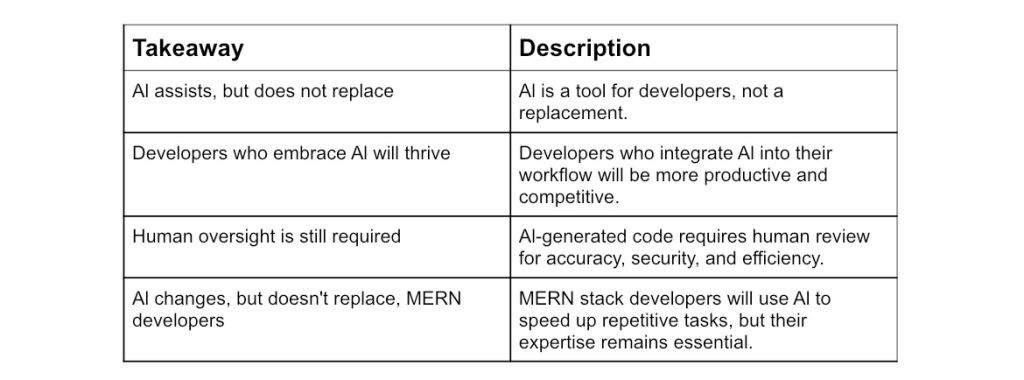
In conclusion, AI is not a replacement for MERN stack developers but rather a powerful tool that enhances their work. AI tools will assist in automating repetitive tasks, optimizing performance, and streamlining debugging processes, allowing developers to focus on more creative and complex aspects of development. The expertise of MERN developers in areas such as architecture, business logic, and user experience will remain essential, and AI will simply serve as an assistant to help them work more efficiently and effectively. By embracing AI and adapting their workflows, MERN stack developers will continue to be at the forefront of innovation in software development, equipped with powerful new tools to help them thrive in an increasingly AI-driven world.
The Future: AI and Developers Working Together
The future of software development is shaping up to be one where human developers and AI tools work closely together, complementing each other’s strengths to create more efficient, innovative, and high-quality software. This collaboration will take several forms, each enhancing the development process in different ways:
- AI as a Junior Developer: In the future, AI will take on the role of a junior developer by handling routine and repetitive tasks that would otherwise consume a significant portion of a developer’s time. Tasks such as generating boilerplate code, automating tests, and even providing code suggestions will be managed by AI, allowing human developers to focus on more complex and intellectually stimulating challenges. This will enable developers to work more efficiently, reduce the time spent on mundane tasks, and accelerate the overall development cycle.
- Human-AI Pair Programming: Another way AI will contribute to software development is through a “pair programming” model, where developers and AI work side by side. In this setup, AI will assist by suggesting improvements to the code, detecting potential bugs early in the process, and even refactoring code for optimization. However, the decision-making power will remain firmly in the hands of human developers, who will be able to leverage AI as a tool that enhances their expertise. This partnership will allow for more efficient coding while ensuring that developers retain full control over the direction and quality of the software.
- More Focus on Creativity & Strategy: As AI continues to handle the more routine aspects of development, human developers will have the opportunity to shift their focus toward more creative and strategic tasks. With the automation of repetitive coding tasks, developers will have more time to dedicate to designing software architecture, implementing innovative solutions, and enhancing user experiences. These areas require human intuition, creativity, and problem-solving abilities, which AI, despite its impressive capabilities, cannot replicate. The future of development will be driven by the creativity and strategic thinking of human developers, with AI acting as a powerful ally that amplifies their capabilities.
Ultimately, this collaborative model between human developers and AI will not only boost productivity but also lead to the development of better software solutions, as both entities combine their strengths in a harmonious way.
Final Thoughts: AI Is a Tool, Not a Threat
AI-powered coding assistants are not designed to replace developers but to work alongside them, providing valuable assistance in various aspects of the development process. These tools can significantly accelerate development by automating repetitive tasks, improving code quality, and providing real-time suggestions that enhance productivity. They also help developers learn more efficiently by offering insights, debugging assistance, and guidance on best practices. While these AI tools are powerful, they cannot replicate the depth of human creativity, the ability to solve complex, real-world problems, or the strategic thinking required to build innovative software solutions. Developers bring unique qualities to the table—skills that go beyond mere code generation—that AI cannot replace.
Key Takeaways:
So Should You Worry About AI Replacing Developers?
The short answer is no, you don’t need to worry about AI completely replacing developers. While AI can certainly assist with specific, repetitive tasks like code generation, error detection, and basic debugging, it is still far from being able to replace human developers. AI lacks the fundamental abilities that make human developers irreplaceable, such as creativity, critical thinking, and complex problem-solving. These are essential skills that developers bring to the table when designing innovative solutions, adapting to new challenges, and strategically solving problems in ways AI simply cannot match.
AI may be able to assist with specific aspects of software development, but it is not capable of understanding the broader business context, the nuanced needs of users, or the high-level architectural decisions required to build scalable, maintainable, and secure applications. Instead of replacing developers, AI will serve as a powerful tool that enhances their workflow and boosts their productivity. By automating mundane tasks, AI allows developers to focus on more complex and creative aspects of software creation, making their work faster, more efficient, and ultimately more innovative.
As AI tools continue to evolve, the landscape of software development will change, and developers who can effectively leverage these tools will be in a better position to succeed. In fact, those who embrace AI and learn how to work alongside it will likely become more competitive in the industry. It will enable them to write cleaner code, make better decisions, and enhance the overall quality of the applications they build.
So, should you start learning how to integrate AI into your workflow? The answer is a resounding yes. Understanding AI’s potential and how to work with it will make developers more adaptable, innovative, and better prepared for the future. Those who choose to ignore these advances may find themselves at a disadvantage as the industry continues to shift toward AI-assisted development. In the end, AI is a tool, not a replacement, and learning to use it effectively will allow developers to stay relevant, enhance their skills, and continue to contribute meaningfully to the tech industry.
This comprehensive breakdown serves to clarify the role of AI in software development and offers developers a roadmap for adapting to this evolving landscape, ensuring they remain at the forefront of innovation and continue to thrive in an increasingly AI-driven world.