
Negotiating a higher salary as a tech professional can often feel like facing a major coding challenge; complex, nerve-wracking, and requiring precision. After all, you’re not just discussing numbers, but your value, your skill set, and how they align with what the company is offering. Much like coding, salary negotiation is an art that demands the right strategy, confidence, and insight into both the industry and your own worth. It’s about navigating through a landscape filled with variables, such as your role, experience, location, and market conditions, while also factoring in your long-term career goals.
Whether you’re a software developer, data analyst, UX designer, or a product manager, the ability to negotiate a higher salary isn’t an elusive, once-in-a-lifetime skill reserved for CEOs or corporate bigwigs, it’s one that anyone in the tech industry can learn and excel at. The best part? It doesn’t take a high-stakes boardroom drama or an intimidating conference call with HR to secure the compensation you deserve. With the right tools and preparation, salary negotiation becomes less of a “game of chance” and more of a strategy-based conversation where both sides have clear expectations and understanding.
Before you start envisioning yourself in an intense negotiation session with sharp minds at the table, it’s important to step back and break down the process into manageable and actionable steps. It’s not just about how much you can get away with asking for, it’s about knowing your value, having the data to back it up, and approaching the conversation with confidence and clarity. By the end of this article, you’ll not only understand how to successfully negotiate a higher salary but also be prepared to walk into that conversation with all the tools and strategies you need to come out on top.
So, let’s put the pressure of salary talks aside and look at the process with the same level of rationality, methodical planning, and clear steps that you would apply to any technical project. With the right preparation, you can not only achieve your salary goals but also establish a professional foundation for future negotiations, whether in your current company or with future employers. Ready to start? Let’s break it down.
1. Understand the Importance of Salary Negotiation
Before you even consider entering a salary negotiation, it’s essential to first understand why salary negotiation matters and why it’s so crucial in your professional journey, especially in the tech industry. Many tech professionals are reluctant to initiate salary conversations, assuming that their expertise speaks for itself or that the employer’s first offer is the best they will get. However, if you’ve ever felt like your skill set deserves more or that your compensation doesn’t quite reflect the value you bring to the table, then it’s time to reframe your perspective and realize how important salary negotiation truly is.
In the tech industry, salaries are known for varying significantly, even within the same role, depending on factors like your technical expertise, geographic location, and company size. For example, a software developer with specialized skills in machine learning might command a different salary than one focused on frontend development, even if they both have similar years of experience. And while the demand for tech professionals is at an all-time high, just because you’re highly sought after doesn’t mean you should settle for the first offer you receive. Instead, knowing how to negotiate a higher salary is a critical skill that requires a balanced approach, part strategy, part psychology, and a good dose of confidence.

Salary negotiation isn’t just about securing a higher paycheck. It’s as much about recognizing your worth and advocating for yourself in a way that aligns your financial compensation with your skill set and contributions. If you don’t speak up for yourself and your value, who will? The unfortunate truth is that many tech professionals miss out on higher salaries or benefits simply because they didn’t push for what they deserved. In essence, salary negotiation is not only about asking for more money but also about ensuring that you’re valued appropriately for the work you do.
But why is salary negotiation such a key part of your career growth? Let’s break it down:
- Financial Growth
A higher salary is more than just a number, it’s an indicator of your expertise and the impact you’ve made in your field. The more you grow as a tech professional, the more your compensation should reflect that growth. Securing a higher salary allows you to reinvest in your career, whether by pursuing further education, certifications, or attending conferences to stay on top of new trends. It can also provide you with the financial security you need to make smarter life decisions, whether it’s saving for the future, investing in new tech equipment for your personal projects, or even taking calculated career risks without worrying about the financial implications.
Moreover, a higher salary can also boost your confidence. Knowing that you are receiving compensation in line with your skills and experience fosters a sense of professional fulfillment. When you understand your financial worth, you are more likely to perform at your best, contributing to a cycle of continuous growth.
- Job Satisfaction
Believe it or not, being adequately compensated for your work plays a crucial role in overall job satisfaction. It’s not just about the money; it’s about feeling appreciated for the effort, knowledge, and skills you bring to your role. Being fairly compensated can significantly improve your morale, job engagement, and productivity. When you feel like your work is valued at the level you deserve, it can translate into greater enthusiasm and dedication. On the flip side, underpayment can lead to frustration, burnout, and decreased motivation to perform at your best.
In many cases, tech professionals who feel underpaid may eventually look for new opportunities that offer better compensation. Salary negotiation can help you avoid feeling undervalued, and instead, you’ll feel like an essential part of the organization, further motivating you to contribute your best ideas, solutions, and innovations. Plus, job satisfaction is a key factor in long-term retention, and being paid what you’re worth is a fundamental part of maintaining that satisfaction.
- Career Advancement
A successful salary negotiation is often a sign that you know your value in the market, and that can have a ripple effect on your career trajectory. When you negotiate a higher salary, you are not only advocating for yourself but also positioning yourself for future career advancement. The way your salary is structured is often a reflection of how much the company values you and how they perceive your worth in the competitive job market.
By negotiating successfully, you’re signaling that you have the confidence and skills to know your worth, which can lead to more opportunities for promotions, leadership roles, or higher-paying positions in the future. It also shows potential employers or current employers that you are someone who understands the business side of things and can communicate effectively about your contributions. In the tech industry, where innovation and expertise are highly prized, being able to negotiate a higher salary can directly correlate with being considered for more responsibility, and ultimately, a more lucrative career path.
In the end, salary negotiation isn’t just about the immediate increase in pay, it’s about setting the stage for future career success and ensuring that your compensation aligns with the value you bring to the table. Whether you’re negotiating your initial offer or asking for a raise, understanding the importance of this conversation can set you on a path toward achieving your financial and professional goals.
So, the next time you find yourself wondering whether salary negotiation is worth the effort, remember that it’s an investment in your career growth, job satisfaction, and long-term success. The sooner you get comfortable with this essential skill, the more empowered and fulfilled you’ll feel in your tech career.
2. Research and Preparation: Know Your Worth
The first step in any successful salary negotiation is arming yourself with knowledge. It’s not just about walking into a negotiation with confidence; it’s about ensuring that confidence is grounded in solid, well-researched data. The power of research can’t be underestimated when it comes to negotiating a higher salary. To do so effectively, you need to understand your market value and know what you bring to the table. So, how do you go about doing that? Let’s break it down.

- Know the Industry Standards
Tech salaries in Africa can vary greatly depending on factors such as role, location, company size, and even the specific tech sector in which the company operates. For example, a senior software developer in South Africa might earn significantly more than a developer in smaller cities across Nigeria or Kenya. Understanding this geographical disparity is key to ensuring that your salary expectations are realistic and competitive within your local context.
In African markets, salary ranges can also be influenced by the maturity of the tech ecosystem, the demand for specific skills, and the level of infrastructure development. A software developer with expertise in emerging technologies such as Artificial Intelligence (AI), machine learning, or blockchain will command a higher salary than someone with more traditional skills in areas like web development.
To start, you can rely on platforms like Glassdoor, Payscale, and LinkedIn Salary Insights for salary information. While these resources might provide general insights into compensation, it’s essential to consider local platforms or country-specific data as well. Websites like MyJobMag (Nigeria), BrighterMonday (Kenya), and Jobberman (Ghana) often provide salary guides and insights into the regional tech job market. Consulting local recruiters or peers within the industry can also provide valuable context and help you benchmark your compensation expectations more accurately.
After conducting thorough research, aim for the higher end of the salary range if your experience, technical skills, and professional accomplishments align with it. This ensures that you don’t undervalue your expertise in the negotiation process.
Here’s a breakdown of some typical salary ranges for tech professionals in Africa in 2025, based on role, experience, and location:
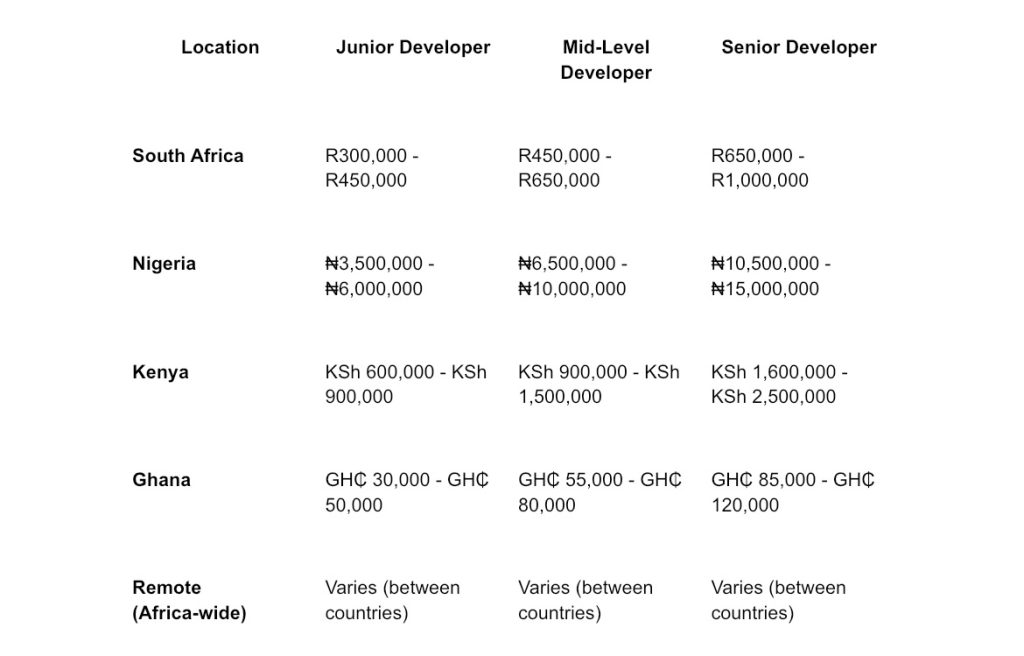
As seen in the table, there is a clear distinction in salary ranges based on country and experience level. South Africa leads the pack, followed by Nigeria, Kenya, and Ghana. However, it’s important to note that remote roles, particularly for positions requiring cutting-edge skills like data science, cybersecurity, or cloud engineering, may offer salaries that are comparable to those in higher-paying global markets, especially if the company is based in the US, Europe, or other developed regions.
Having this data will help you assess where you stand relative to others in your field. It will also give you leverage in your negotiations, ensuring that your salary expectations align with the broader market while considering your unique experience and skills.
- Evaluate Your Skills and Experience
Salary negotiation isn’t just about knowing what the average salary is for your role, it’s about proving why you deserve the higher end of the range. Understanding how your specific skills and experience stack up to the broader industry expectations is critical.
Take a moment to assess your experience. Ask yourself:
- How many years of experience do I have in this role?
- What technologies or programming languages am I proficient in?
- Have I completed any certifications, special projects, or leadership initiatives that set me apart from others?
It’s important to remember that in the tech industry, specialized skills are often compensated at a higher rate. For example, tech professionals with expertise in emerging technologies like artificial intelligence (AI), cloud computing, and cybersecurity tend to earn more than those with more generalized or traditional skills. If you possess these in-demand skills, you have a strong argument for asking for a higher salary than the average.
- Understand the Company’s Salary Band
Most companies have a structured salary band for each role. These salary bands are typically defined by factors like job level (junior, mid-level, senior), industry standards, and geographic location. It’s crucial to understand whether the company you’re negotiating with is willing to be flexible with their salary bands or if they are rigidly sticking to them.
If you’re already employed and negotiating a raise, it’s a good idea to research how salaries are structured within your organization. You can speak with colleagues who are in similar roles, reach out to mentors, or even have informal conversations with HR (if appropriate) to gather insight into the company’s approach to compensation. Having this inside knowledge will empower you to negotiate effectively and will help you avoid asking for a figure that’s too far out of line with the company’s standard salary bands.
- Factor in Benefits and Perks
When it comes to salary negotiation, don’t forget about the full compensation package. A higher salary is just one aspect of your total compensation, but many tech professionals are offered an array of valuable benefits and perks that can significantly enhance the overall package. These benefits can sometimes make up for a lower salary if a company isn’t flexible in offering more money upfront.
Consider the full spectrum of benefits offered by potential employers, including:
- Bonuses: Many tech companies offer performance-based bonuses.
- Stock options: These can be valuable, particularly at high-growth companies or startups.
- Remote work opportunities: The flexibility to work from home or set your own hours can have a significant quality-of-life impact.
- Health and wellness benefits: Health insurance, gym memberships, and wellness programs are often offered as part of the total compensation package.
- Paid time off (PTO): Vacation days, sick leave, and personal time off are all essential components of compensation.
When negotiating a higher salary, be sure to consider all of these factors. If a company is unwilling to increase your base salary, they may be open to negotiating other aspects of the package. For example, if the salary is non-negotiable, you might be able to negotiate additional vacation time, more flexible working conditions, or stock options.
By factoring in all these elements, you can gain a comprehensive view of the total value of the offer, helping you make a more informed decision and boosting your ability to negotiate for a better overall deal.
3. Timing is Everything
When it comes to salary negotiation, knowing when to negotiate is just as critical as knowing how to negotiate. Timing can truly make or break your efforts. Negotiating at the wrong time can result in missed opportunities or even a stalled conversation, while negotiating at the right moment can lead to an outcome that benefits both you and the employer. Understanding when the time is right to ask for a higher salary is essential for maximizing your chances of success. Here are some of the best moments to consider when negotiating a higher salary:

- After a Successful Interview
The moment after you’ve completed a technical interview and received positive feedback is arguably one of the best times to start the salary conversation. Why? At this point, the employer is already excited about the prospect of bringing you on board. If they’ve spent the time interviewing you, evaluating your technical skills, and seeing the potential you bring to the role, they are likely eager to make you an offer.
When the employer is in “recruitment mode,” they are typically more open to discussing salary terms because they want to lock down the best candidate as soon as possible. If you wait until you’ve been formally offered the job, you may lose some leverage since the company is already emotionally invested in hiring you. By introducing the topic of salary early on, you can guide the conversation toward your ideal compensation package while the employer is still highly motivated to make a deal.
At this stage, be prepared to discuss your desired salary range based on your research, skill set, and the market value of your position. Make sure you’ve done your homework and understand the industry standards so that you’re negotiating from an informed position.
- During Performance Reviews
Annual performance reviews are another prime opportunity for salary negotiations. By the time you reach your performance review, you’ve already had a year (or more) of demonstrating your value to the company. Your manager has likely evaluated your contributions, and the performance review meeting is the perfect moment to reinforce the impact you’ve made on the team and the organization.
When negotiating during a performance review, come prepared with evidence of your achievements. This could include things like:
- Improved team efficiency: Did you help streamline workflows, introduce automation, or mentor junior team members?
- Successful product launches: Have you contributed to the successful release of products that contributed to company growth or customer satisfaction?
- Tackling tough challenges: Were you the go-to person when critical issues arose? Did you help solve problems that led to cost savings or increased revenue?
Providing tangible examples of your achievements will make your request for a higher salary more persuasive. If you can clearly demonstrate how your work directly contributed to the company’s success, it becomes easier for your manager to justify increasing your salary.
Also, remember that performance reviews are not just about your work accomplishments but about your potential for growth. Use the review as an opportunity to discuss your future with the company, where you see your career going, and how your compensation should align with your evolving responsibilities and skills.
- When You’re Offered a New Role
Whether it’s a promotion or a new role within the company, this is another key moment when negotiating a higher salary is essential. Internal promotions can be a strategic opportunity to boost your compensation. Employers view these moments as chances to retain talent, reward your growth, and keep you engaged in the company long term.
When offered a new role or promotion, it’s important to consider the expanded responsibilities and how they justify a higher salary. For example, if you’re moving from a senior developer role to a lead engineer position, you’ll likely be taking on leadership responsibilities, managing projects, and overseeing teams. These added responsibilities typically warrant an increase in pay.
Additionally, internal promotions can often give you more leverage in salary negotiations because the company has already invested time and resources in training and developing you. They’re likely to want to retain you, and a well-timed negotiation can help ensure your compensation reflects the new challenges you’ll be facing in the upgraded role.
If the company is serious about promoting you, they’ll likely want to offer a competitive salary that reflects your new level of responsibility. Be prepared to negotiate for a package that matches the value you will bring to the company in your new role. Be sure to emphasize the skills, experience, and leadership you’ll provide, making the case for why you deserve the higher salary.
4. How to Negotiate a Higher Salary: The Conversation
Now that you’ve done the research, evaluated your skills, and timed the moment perfectly, it’s time for the most important part: the conversation. This is where your preparation truly shines, and your ability to communicate effectively will make or break the outcome of your negotiation. Here’s how you can structure your approach to ensure a successful salary discussion.
- Be Clear About Your Expectations
One of the most crucial aspects of negotiating a higher salary is clarity. When you enter the conversation, make sure you’re direct and crystal clear about your salary expectations. Avoid vague statements like “I’m flexible” or “I’m open to anything.” These phrases will only leave room for ambiguity and may not give you the leverage you need. Instead, state your salary expectations confidently and back them up with solid reasoning.
For example, you might say something like:
“Based on my research and my understanding of the market, I’m looking for a salary in the range of $110,000 to $130,000. This range aligns with my experience, the skills I bring to this role, and the current market conditions for positions like mine.”

Being upfront and specific shows that you know what you’re worth, and it gives the employer a clear starting point for the negotiation. This also sets a professional tone for the conversation, demonstrating that you’re well-prepared and serious about the discussion.
- Justify Your Request
While it’s essential to be clear about your salary expectations, it’s just as important to justify why you believe you deserve that salary. Simply stating a number isn’t enough; you need to explain why you are worth it. Back up your request with concrete examples of your achievements, experience, and the unique value you bring to the role.
For instance, if you’re a software developer who’s been working with cutting-edge technologies or have led a highly successful project, don’t be shy about highlighting those accomplishments. Here’s how you might frame it:
“I’ve developed a deep understanding of JavaScript frameworks and have used that expertise to contribute to several successful projects here. For example, I led the XYZ project, which resulted in a 15% reduction in operating costs for the company. These are the kinds of impactful contributions I bring to my work, and I believe they justify a salary in the range we’re discussing.”
When you can clearly connect your achievements to the value you bring, it becomes much easier for the employer to understand the reasoning behind your salary request. It shifts the conversation from just a number to a discussion of your contributions and long-term potential.
- Be Prepared for Pushback
It’s rare for salary negotiations to go smoothly without any resistance. In most cases, the employer will push back to some extent, whether by offering a lower salary or citing budgetary constraints. This is completely normal, and it’s essential to remain calm and composed during this stage. Instead of getting defensive or frustrated, listen attentively to the employer’s concerns and try to understand their position.
If the employer pushes back, it’s important to respond thoughtfully. Reaffirm why your request is reasonable, and be open to further discussion. Here’s an example of how to handle pushback:
“I understand that budget constraints can be a factor, but I’ve done extensive research on market salaries for this role, and based on my skills and experience, I believe the salary range I provided is fair. If that range is not possible at this time, I would be open to discussing other forms of compensation that would align with my value to the company.”
Sometimes, employers may not be able to meet your salary expectations, but they might be willing to offer other forms of compensation. Be open to discussing alternatives such as:
- Additional vacation time: If salary is non-negotiable, more paid time off can be a great compromise.
- Performance bonuses: These bonuses are often tied to meeting specific company goals and can be a way to boost your overall earnings.
- Stock options: Especially in startups or high-growth companies, stock options can add substantial value to your overall compensation package.
- Opportunities for professional development: If salary flexibility is limited, investing in your career growth through further training, certifications, or conferences can be a valuable form of compensation.
Being flexible and open to alternatives can help you secure a compensation package that feels right, even if the base salary isn’t exactly what you expected.
- Know When to Walk Away
In any salary negotiation, one of the most important skills is knowing when to walk away. If the employer is unwilling to meet your expectations or provide any reasonable alternatives, you may need to make the tough decision to decline the offer or walk away from the negotiation. This can be difficult, but it’s crucial to trust your instincts and be confident in the value you bring to the table.
If the company refuses to meet your salary expectations and isn’t willing to offer other benefits or opportunities, it may be a sign that this particular offer is not the right fit for you. Continuing to push for a better deal when the employer is unwilling to budge could lead to frustration or a compromise that leaves you dissatisfied in the long term.
Remember, salary negotiations are a two-way street. If you feel that the offer is misaligned with your skills, experience, and market value, trust that there are other opportunities out there that will better align with your expectations. Walking away isn’t a failure, it’s about knowing your worth and making sure that the next opportunity you pursue will offer the compensation and professional growth you deserve.
5. How to Negotiate a Higher Salary When You’re Already Employed
Negotiating a higher salary while already employed presents a unique set of challenges. Unlike the straightforward negotiation that happens when you’re entering a new role, asking for a salary increase while in your current position requires you to not only prove your worth but also demonstrate that your contributions have significantly impacted the company. With the right approach, though, you can successfully negotiate a salary increase. Here’s how to proceed:

- Track Your Achievements
The first step in negotiating a higher salary when you’re already employed is to gather evidence of your accomplishments. Unlike external job offers, where your qualifications and market value are more immediately apparent, asking for a raise requires you to demonstrate that you have consistently added value to the company.
Start by compiling a comprehensive list of your achievements since your last salary review. Be specific and use data whenever possible. The more tangible evidence you provide, the stronger your case will be. Some key areas to focus on include:
- Led successful projects: Did you spearhead any projects that brought measurable improvements? Perhaps you led the development of a new feature, or you managed a project that resulted in increased revenue or customer satisfaction.
- Increased team productivity: Have you introduced any processes, tools, or methods that enhanced team efficiency? Maybe you introduced a new software tool or improved collaboration between teams, which led to faster delivery times.
- Improved software performance or user engagement: If you’re a developer, designer, or data analyst, demonstrating that you’ve improved the performance of a product or increased user engagement can be a powerful justification for a raise. Highlight metrics like improved site speed, higher user retention rates, or increased traffic.
Gathering all this information helps you build a strong, data-backed case that shows your value and why a higher salary is justified.
- Request a Meeting with Your Manager
Once you’ve tracked your achievements, it’s time to ask for a formal meeting with your manager to discuss your performance and compensation. This is a crucial step because it shows you’re taking the request seriously and want to discuss it in a professional, focused manner. Don’t attempt to negotiate casually during a lunch break or in passing. Set aside dedicated time to make your case.
When requesting the meeting, be respectful and clear about the purpose. You could say something like:
“I’d appreciate the opportunity to sit down and discuss my performance over the past year, as well as my current compensation. I’ve made some contributions I’d like to review with you, and I think it’s the right time to discuss my career progression and compensation moving forward.”
This approach gives the impression that you are serious, organized, and proactive. It also sets the tone for a formal conversation where both parties can address the issue professionally.
- Present Your Case Confidently and Professionally
During the meeting, it’s essential to present your case in a confident and professional manner. Be clear about why you believe a salary increase is warranted. As mentioned earlier, your achievements and contributions should be the backbone of your argument. Show your manager that your work has had a measurable impact on the company and that a salary increase is a reflection of the value you’ve brought to the table.
For example:
“Over the past year, I’ve successfully led the implementation of a new feature that has led to a 20% increase in user engagement. Additionally, I’ve taken on more responsibility by mentoring junior team members and streamlining our development processes, which has increased the team’s overall productivity by 15%. Given these accomplishments, I believe my salary should better reflect the value I’ve brought to the team.”
Make sure to approach the conversation from a positive, forward-thinking angle. You’re not just asking for a raise because you want more money; you’re explaining how your work directly contributes to the company’s success and how your compensation should align with that.
- Be Ready to Discuss Your Future Goals
In addition to talking about past accomplishments, it’s also important to discuss your future goals and how you plan to continue contributing to the company’s success. This shows your commitment to growth and indicates that you view your salary increase as part of an ongoing relationship with the company, not just a one-time request.
You might say something like:
“Looking ahead, I’m excited about the upcoming projects and initiatives. I plan to take on additional responsibilities, and I’m particularly interested in leading the next phase of product development. I’m confident that these efforts will further drive the success of the team and company, and I’d like my compensation to reflect this continued growth and contribution.”
This shows your manager that you are invested in both your own development and the company’s success. It can also give them confidence that investing in your compensation now will pay off in the long term.
- Consider a Performance-Based Increase
If the company isn’t in a position to offer an immediate raise, consider negotiating a performance-based increase. This approach involves agreeing to a timeline and setting specific, measurable goals that, if met, will trigger a salary review. It gives your manager a chance to see more concrete results and provides a clear pathway to the raise you’re seeking.
For example, you might suggest:
“If the budget doesn’t allow for an immediate raise, I’d be open to discussing a performance-based increase. I’d be happy to set specific goals, such as increasing team output by X% or leading the launch of the next product iteration, and if I meet these targets within the next six months, we can revisit my salary at that time.”
This allows you to demonstrate your confidence in your ability to deliver and gives the company time to adjust its budget or salary structures accordingly. It also shows flexibility on your part, which can work in your favor during negotiations.
Conclusion: The Power of Negotiation
Negotiating a higher salary as a tech professional isn’t just about demanding more money, it’s about asserting your worth and ensuring that your compensation accurately reflects the value you bring to the table. It’s about understanding the dynamics of the market, being armed with the right data and research, and having the confidence to stand your ground when necessary. Salary negotiation is an important skill that goes beyond simply getting a paycheck; it’s a tool for advocating for yourself and shaping the trajectory of your career.
By following the steps outlined in this guide, you will not only increase your chances of securing a higher salary but also set yourself up for long-term career success. Whether you’re a developer, designer, data analyst, or any other tech professional, mastering the art of salary negotiation will empower you to get the compensation you deserve. It also boosts your self-esteem, motivation, and sense of accomplishment. Getting paid what you’re worth directly affects your job satisfaction and can create more opportunities for growth, promotions, and future roles that align with your career ambitions.
Remember, the next time you walk into a negotiation, you’re not simply asking for more money. You’re advocating for the recognition of your contributions, expertise, and the value you add to your team and company. This recognition is something every tech professional deserves, and with the right approach, you’ll ensure that your compensation aligns with the skills and experience you bring to the table. So, go ahead – take charge of your career and start negotiating with the confidence and strategy that will lead to greater success and fulfillment in the tech industry.